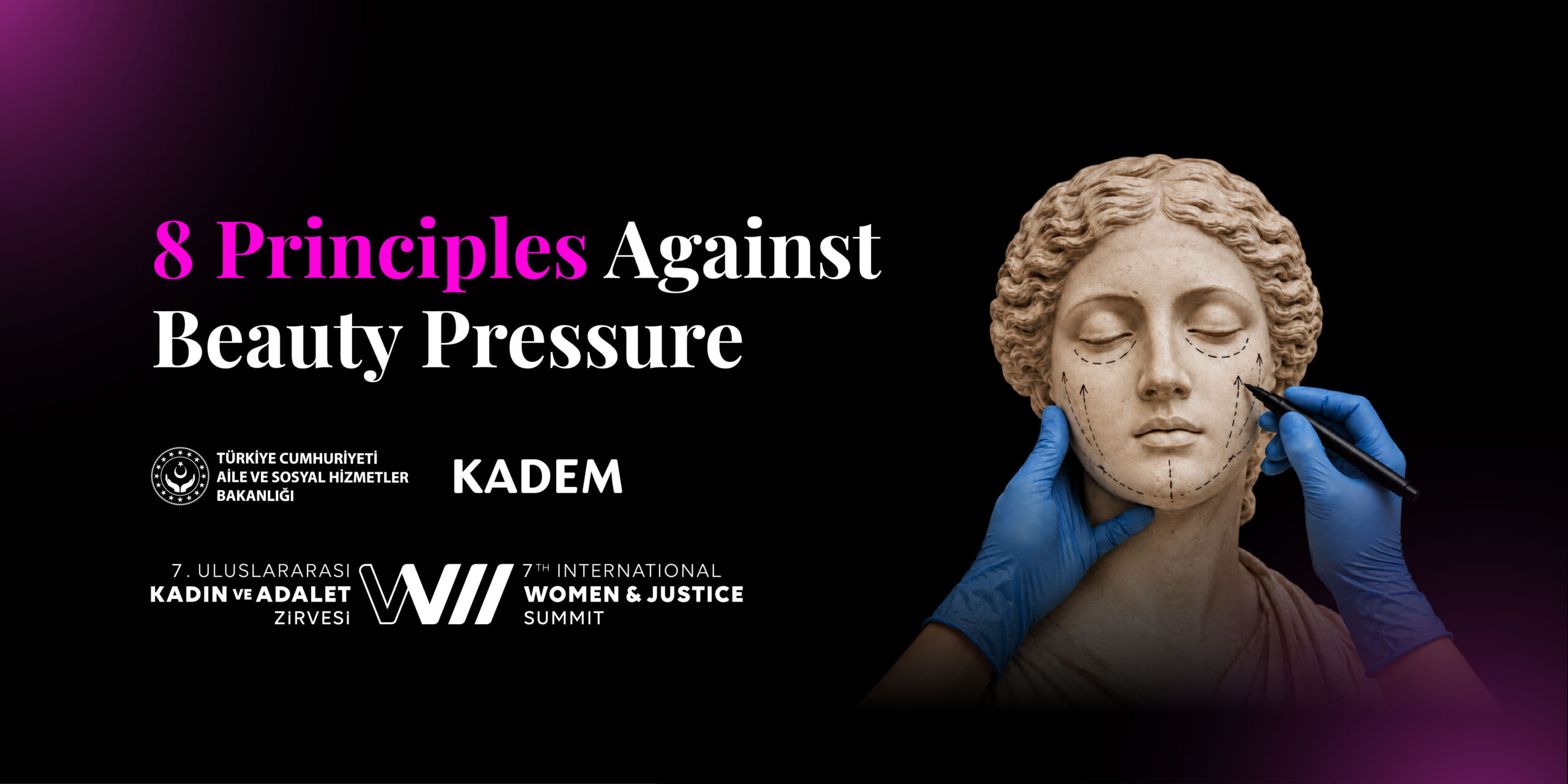
KADEM 7th International Women and Justice Summit
Constructed Beauties
21–22 November 2026
Summit Declaration
As we conclude the 7th International Women and Justice Summit, held under the theme “Constructed Beauties,” we would like to revisit the questions at the heart of our discussions: Who decides how women should look, and according to what standards? How do these expectations affect women’s lives? The perspectives shared over the past two days have demonstrated that the pressures surrounding perceptions of beauty affect women in many areas of life, from how they perceive themselves to their social standing and access to opportunities.
In her keynote address, Dr. Nazife Şişman offered a thought-provoking point of departure: no law requires a woman to be beautiful. Yet in working life, in the public sphere and even in a woman’s relationship with herself, there is a price to be paid for not appearing beautiful. This price is seldom recognised as an injustice; it is experienced instead as a personal shortcoming. Over the course of these two days, we have sought to name what lies behind it.

By “constructed beauties,” we mean beauty ideals shaped and promoted through the media, the marketplace, digital platforms and societal expectations, and presented as though they were the only valid standards, even as they change over time. Let us state clearly that an interest in beauty, an appreciation of aesthetics, and practices of personal care and adornment are natural and culturally embedded aspects of human life. What we seek to bring into question is the reduction of women’s physical appearance to a measure of their worth and the pressure placed on them to conform to specific beauty standards.
Beauty standards do not emerge of their own accord; they are produced. They are produced by platforms that bring certain faces to the top of our screens, by brands that recast every natural change as a flaw, by advertising that markets the flaw and its remedy at the same time, by clinics, and by employers who reward a “well-groomed” appearance. Each new standard gives a name to a new flaw, and beside each flaw a product stands ready to correct it.
As the keynote address reminded us, every actor in this chain offers the same answer: the algorithm merely follows user interest; the company is simply meeting demand; the patient requested it; the customer expects it. Responsibility thus moves down the chain until it settles where power is weakest: on the woman who, we are told, made the choice.
Where do we stand in all this? As the Women and Democracy Foundation (KADEM), we are guided by our principle of “equality in existence, justice in responsibility” and our values of “trust, dignity and justice.” We regard the pressure that certain beauty ideals place on women as a matter of justice that must be addressed in terms of human dignity, health, safety, identity and equal opportunity. Our aim is not to replace one conception of beauty with another. Rather, we believe that no beauty standard should become an obligation that determines women’s worth, reputation or opportunities in society.
In light of the discussions held at this summit, we would like to share with the public eight fundamental principles and calls to action.
1. A person’s worth cannot be measured by their appearance.
Being perceived as beautiful must never be a prerequisite for being treated with respect, being recognised as successful or accessing any right. Women’s choices concerning their appearance, including their decision not to alter it, deserve equal respect.
2. Beauty standards have social and institutional implications.
The media, employers, digital platforms and industry representatives bear responsibility for the consequences that the beauty standards they create and promote have for women’s lives. Evaluating women on the basis of their appearance rather than their professional qualifications, knowledge and skills is a form of discrimination that undermines equal opportunity.
Discrimination based on age, physical characteristics, clothing or appearance must not be normalised in recruitment, promotion or public life. We call on employers to refrain from imposing appearance requirements unrelated to professional competence. Effective procedures and monitoring mechanisms must be developed to identify and remedy violations in this area.
3. Digital technologies must respect differences and diversity.
Filters, retouching and AI-generated imagery are playing an increasingly influential role in shaping our perception of how a face should look. Transparency must be ensured to prevent the misleading use of these technologies, and measures must be taken to prevent algorithmic systems from reproducing biases based on age, skin colour and physical characteristics.
We call for clear disclosure of digital alterations that promote unrealistic beauty standards, particularly in advertising and commercial content. We expect advertisers, content creators and digital platforms to be transparent about image manipulation and to protect users, especially children and young people, against misleading practices. Furthermore, effective legal protection mechanisms must be established against manipulated images created or circulated without women’s knowledge or consent.
4. The economic and social costs of beauty expectations must be made visible.
Women bear the cost of these expectations in time, money and labour. We call for research into how beauty expectations affect women’s time, financial resources and working lives, and for inequalities in this area to be brought to light through concrete data. Gender-based price differences for comparable products and services must also be examined from the perspectives of consumer rights and economic justice.
Marketing strategies and misleading advertisements that fuel feelings of inadequacy among women must be effectively regulated. In the cosmetics and aesthetic industries, attention must be paid not only to consumer safety but also to the health, safety and working conditions of those employed in these sectors.
The market must be held accountable for what it produces. Those who continuously create and promote new beauty standards that turn natural features and changes into perceived shortcomings must take responsibility for doing so. The marketing of products, services and aesthetic procedures must not exploit women’s insecurities or present commercially constructed ideals as necessities.
5. Awareness of these pressures must be fostered from an early age.
Children and young people should not grow up measuring their worth by their appearance or by the approval of others. We therefore emphasise the importance of strengthening critical media literacy in schools, promoting language within families that supports children’s self-esteem, and ensuring access to psychosocial support services for everyone who needs them.
Particular attention must be paid to the effects of appearance-based comparisons and feelings of inadequacy during adolescence on young people’s mental well-being. We call for greater preventive and remedial efforts in educational settings to address appearance-based teasing, humiliation and peer bullying.
6. Women deserve respect at every stage of their lives.
The changes that accompany adolescence, the menstrual cycle, pregnancy, the postpartum period, menopause and ageing are natural parts of women’s lives, not problems to be corrected. Ageing, in particular, is not an illness to be eliminated but a natural part of life’s cycle. The lines that mark women’s faces with age are not flaws to be erased, but traces of a life lived.
We reject the portrayal of these natural changes as imperfections and the constant pressure placed on women to look a certain way. We advocate for women’s access to healthcare, accurate information and the support they need at every stage of life. We particularly emphasise that women’s healthcare needs during pregnancy, the postpartum period and menopause must not be overshadowed by expectations concerning their appearance.
7. A single beauty standard cannot be imposed on all women.
Skin colour, hair texture, age or disability must never be grounds for making women invisible or excluding them. Women’s choices regarding their clothing and the expression of their beliefs must not become barriers to their participation in education, employment or public life.
We are mindful that perceptions of beauty have evolved throughout history and vary across cultures. The promotion of certain appearances through global media and markets as universal standards must not lead to the devaluation of local and cultural differences. No conception of beauty should become a means of asserting superiority over women or determining their worth.
We therefore call for the media and other communication channels to represent women of different ages, appearances and life experiences, and above all to make them visible for their contributions, knowledge, ideas and achievements.
8. We oppose the use of women’s appearance and privacy as instruments of coercion.
Women must feel safe in public spaces, just as they should in every other sphere of society. Objectifying, humiliating, shaming, threatening or controlling women on the basis of their appearance is unacceptable. Women’s privacy and personal boundaries must be respected under all circumstances.
Our commitment to protecting women’s human dignity and privacy applies equally in times of war and conflict. The suffering and images of women affected by violence must never be turned into spectacles; their privacy, consent and human dignity must be protected under all circumstances. Impunity for violence against women must be challenged, and mechanisms for effective investigation, fair trial and survivor protection must be strengthened. The voices and needs of women who have experienced violence must be prioritised, and they must have access to long-term support services.
…
As we approach 25 November, the International Day for the Elimination of Violence against Women, we would like to reiterate the following in conjunction with our eight-point call to action: respect for women’s human dignity, privacy, choices and safety is one of the fundamental conditions of a just society.
Systematically humiliating, devaluing, shaming or controlling women on the basis of their appearance is psychological violence. We oppose the normalisation of appearance-based language and behaviour used to intimidate, punish or exert pressure on women. We reject the notion that women’s appearance and privacy are matters subject to the control of others.
KADEM calls on public institutions, academia, the media, digital platforms, the beauty industry and civil society to assume responsibility in line with these principles, through research, education, ethical guidelines and actionable policies. We aim to share the insights and recommendations emerging from this summit with all relevant institutions and stakeholders, and to sustain research, awareness-raising initiatives and collaborative efforts in this area together.
We began this summit with a question: who decides how women should look? We conclude with a truth that is not for anyone to decide or change:
Every woman has dignity and worth, first and foremost, simply because she is human.
Thank you.