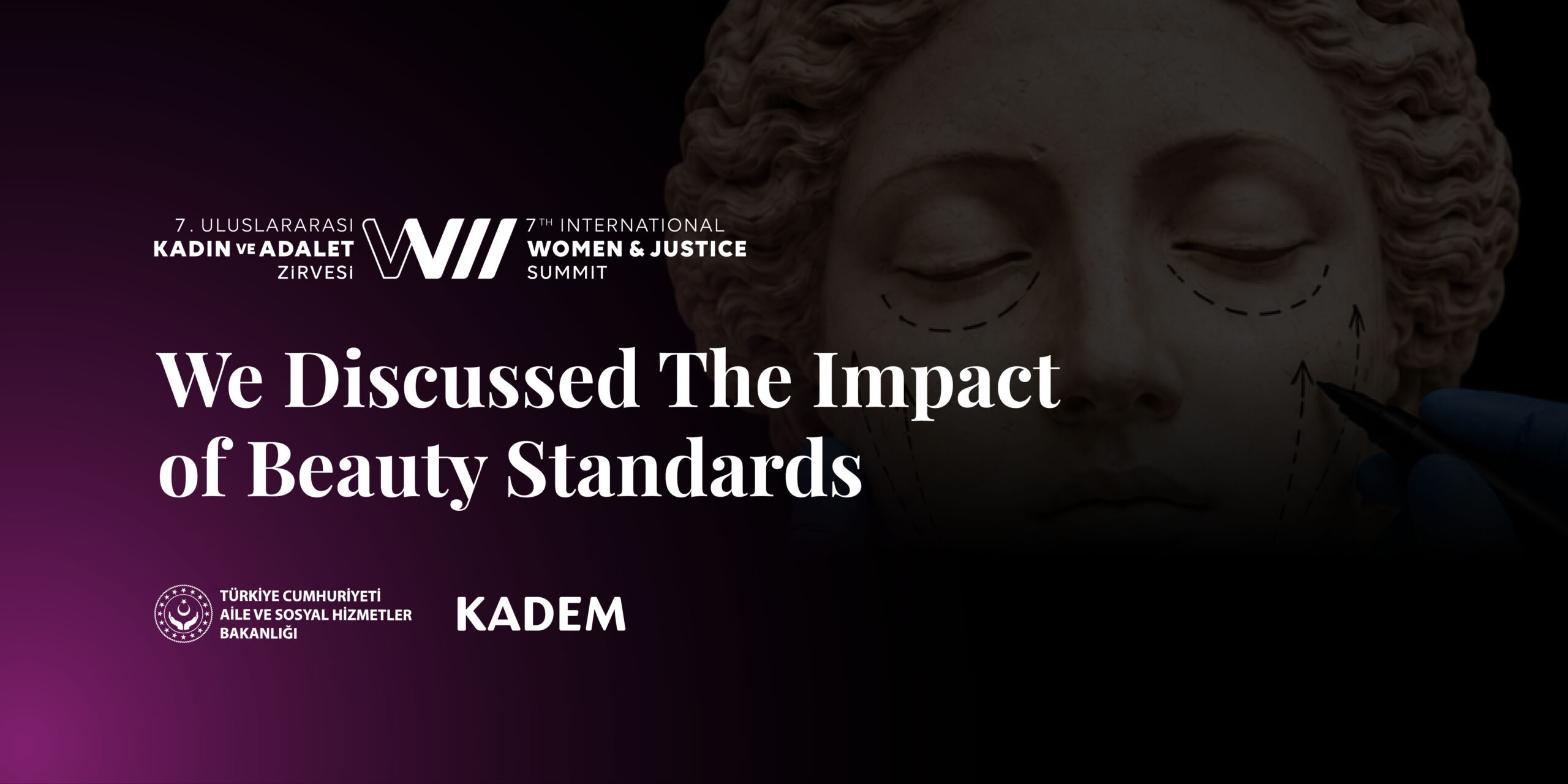
WE DISCUSSED THE IMPACT OF BEAUTY STANDARDS
Held under the theme “Constructed Beauties,” the 7th International Women and Justice Summit opened a global dialogue on how beauty standards can turn into instruments of pressure and inequality in women’s lives. Addressing the opening session, KADEM Chairwoman Atty. Dr. Canan Sarı stated, “Women do not owe society conformity to prescribed beauty norms. On the contrary, society owes women respect and justice!”
Organized in cooperation with the Ministry of Family and Social Services of the Republic of Türkiye, the 7th International Women and Justice Summit kicked off at the Atatürk Cultural Centre (AKM) in Istanbul under the theme “Constructed Beauties.” Bringing together 27 speakers from 14 countries, the summit convened policymakers, academics, experts, and representatives from media and civil society to examine how judging women by their appearance affects their rights, opportunities, and participation in public life.
Hosted by KADEM to contribute to international discourse on women and justice, the opening ceremony was attended by Minister of Family and Social Services Mahinur Özdemir Göktaş, Chair of the KADEM Board of Trustees Sümeyye Erdoğan Bayraktar, KADEM Chairwoman Atty. Dr. Canan Sarı, alongside international guests, panelists, and numerous distinguished attendees. Over the course of the two-day summit, policymakers, scholars, civil society leaders, and specialists from diverse disciplines are examining how beauty perceptions are constructed and how societal pressure to conform impacts women across education, employment, economic independence, and public participation.
When a Woman’s Appearance Is Placed Above Her Labor, It Becomes a Matter of Justice
In her opening remarks, Atty. Dr. Canan Sarı noted that the Women and Justice Summits bring together knowledge and lived experiences across borders and disciplines to collectively address the barriers preventing women from enjoying equal rights and opportunities.

Emphasizing that this year’s theme questions the conditions under which beauty—often perceived merely as a matter of personal taste—transforms into a barrier restricting access to rights and opportunities, Sarı stated:
“When a woman’s appearance is placed ahead of her labor, knowledge, and competence, the issue ceases to be a matter of personal preference and becomes a question of justice that directly affects access to rights and opportunities.”
Sarı drew attention to how the media, market forces, digital platforms, and social expectations shape perceptions of what is deemed beautiful or acceptable. Underscoring that the summit does not take a stance against beauty, self-care, or women’s personal choices, she continued:
“We do not pass judgment on beauty, self-care, or women’s personal choices. Rather, we challenge the mechanisms of pressure that reduce a woman’s worth to her appearance, erase her agency, and compel her to conform to rigid molds.”
How Global Beauty Norms Shape Local Identities
Another key international focus of the summit is how the aesthetic standards of certain regions and economic power centers are projected as universal ideals. Hierarchies built around skin tone, hair texture, and facial features are being examined through the lenses of cultural belonging, representation, and discrimination.
Pointing out that this pressure extends beyond physical appearance to the very relationship women have with their own identities, Sarı noted, “As a result, women are expected not only to alter their appearance, but also to distance themselves from their own identities and cultural roots.”
Sarı added that the summit also interrogates how colonial legacies continue to fuel beauty hierarchies, drawing attention to narratives that frame the distinct features of different societies as flaws in need of correction.

Unchanging Expectations in the Face of Changing Bodies
Sarı remarked that algorithm-driven aesthetics, filters, and digitally perfected imagery have turned non-existent bodies and faces into benchmarks of reality. She pointed out that presenting physical appearance as a prerequisite for social acceptance during adolescence and youth fuels body dissatisfaction and feelings of inadequacy.
Criticizing the portrayal of natural changes brought on by aging, pregnancy, and childbirth as defects to be fixed, Sarı emphasized that women face a relentless expectation to look perpetually young and flawless even as their lives and responsibilities evolve. She stressed that the toll these expectations take in terms of time, effort, and financial cost must be evaluated alongside women’s economic independence and equal opportunity in the workplace.
Minister Göktaş: “We Must Build a Society That Changes Prejudices Against Women”
Speaking at the opening ceremony, Minister of Family and Social Services Mahinur Özdemir Göktaş said, “A human being’s worth cannot be measured by outward appearance. A woman’s dignity cannot be called into question on the basis of her age, body, attire, or looks. No woman should ever be forced into a specific mold in order to gain acceptance or feel valued. Instead of a society where women feel compelled to constantly change themselves, we must build a society that changes its prejudices against women. True justice is not expecting people to look alike; it is ensuring that they receive equal respect and equal opportunities in all their diversity.”
Dr. Nazife Şişman: “The Beauty Regime Operates Through the Promise of Freedom, Yet Imposes New Pressures”
During the opening program, Summit Scientific Committee Member, sociologist, and author Dr. Nazife Şişman delivered the thematic keynote address titled “The Psychopolitics of Beauty: Agency and Structural Injustice.” Şişman emphasized that beauty has ceased to be a mere personal preference and has instead become a yardstick of human worth, stating, “The beauty regime operates through the promise of freedom, yet imposes new pressures on the individual.”

Şişman further added: “Beauty is no longer simply a question of taste or aesthetics; it has virtually become a measure of human value. The issue is not merely whether women can make their own choices freely, but under what conditions they make those choices. We must shift the debate away from women’s individual decisions to the structures shaping those decisions, and return the responsibility for injustice to the systems that produce it.”

High-Level Representatives from Eight Countries Convene at the Leaders’ Session
Following Dr. Nazife Şişman’s keynote on the first day of the summit, the Leaders’ Session titled “Beyond Flawless Images: Global Cooperation for Women’s Empowerment” was held.
Chaired by Minister Mahinur Özdemir Göktaş, the session brought together Bahar Muradova, Chair of the State Committee for Family, Women and Children Affairs of the Republic of Azerbaijan; Dr. Ing Kantha Phavi, Minister of Women’s Affairs of the Kingdom of Cambodia; Azam Nazeer Tarar, Federal Minister for Human Rights and Federal Minister for Law and Justice of the Islamic Republic of Pakistan; Marie Angélique Mame Selbé Diouf, Minister of Family, Social Action and Solidarity of the Republic of Senegal; Tatjana Macura, Minister without Portfolio in charge of Gender Equality, Prevention of Violence against Women, and Economic and Political Empowerment of Women of the Republic of Serbia; Masagos Zulkifli, Minister for Social and Family Development of the Republic of Singapore; Oğuzhan Hasipoğlu, Minister of Labor and Social Security of the Turkish Republic of Northern Cyprus; and Marija Pletikosa, State Secretary at the Ministry of Labor, Pension System, Family and Social Policy of the Republic of Croatia.
The Leaders’ Session focused on policies and international partnerships grounded in human dignity and justice to counter inequalities stemming from appearance-based judgments of women.
Who Defines Ideal Beauty?
Later in the day, the opening panel titled “The Beauty Regime: Who Defines the Ideal?” took place.
Moderated by our Board Member and Clinical Psychologist Sultan Işık Atalan, the panel featured journalist and broadcaster Muna AbuSulayman, who examined how the media manufactures beauty norms and the price women pay for visibility. Highlighting the media’s role in shaping societal standards, AbuSulayman said, “Repeated visual messages shape how society defines beauty and what it comes to accept as ‘normal.’”

Internationally recognized for her work on colorism, Dr. Sarah L. Webb drew attention to the intersections of beauty politics with race, colonialism, and discrimination. Emphasizing that lighter skin tones are privileged while darker skin tones are devalued and marginalized, Webb noted that the concept of ideal beauty has been constructed on a global scale as a mechanism of hierarchy, exclusion, and domination.

Prof. Dr. Yaylagül Ceran Karataş, faculty member at Istanbul Medeniyet University, explored the relationship between beauty, goodness, and difference. “Aging, vulnerability, and difference are existential possibilities of living beings; a concept of beauty that erases them interrupts the existential narrative of life and prevents life from being ‘seen’ in its wholeness,” Ceran said, adding that beauty is a symbol of the morally good.

The panel explored who sets ideal beauty benchmarks and through which instruments, the role of media and culture in this process, and the impact of homogenized beauty standards on women’s self-esteem and social standing. Speakers underscored that notions of the “ideal body” and “ideal appearance” regulate women’s lives through invisible mechanisms.

Five Thematic Panels Scheduled for Day Two
On the second day of the summit, Sunday, November 22, five thematic panels will address culture and identity, the beauty industry, digital media, women’s safety, and psychological impacts.
Sessions titled “No Single Beauty: Culture, Identity, and Aesthetics,” “The Cost of Beauty: Markets, Bodies, and Women’s Life Cycle,” “The Algorithmic Mirror: Beauty in the Digital Age,” “From Objectification to Dignity: Violence and Women’s Safety,” and “The Feeling of Inadequacy: The Psychological Burden of Beauty” will examine the multifaceted impact of beauty standards on women’s lives.
Academics, journalists, authors, and civil society representatives from around the world—particularly from the United States, the United Kingdom, Australia, South Korea, Saudi Arabia, Kuwait, and Canada—will share their insights throughout the sessions.
The summit will conclude on Sunday, November 22, with the release of its Final Declaration.
8,050 Participants from 62 Countries Across Six Summits
To date, the six editions of the International Women and Justice Summit have brought together 8,050 participants and 220 speakers from 62 countries.
Held this year under the theme “Constructed Beauties,” the summit aims to draw attention to the social dimensions of beauty perceptions, spark debate around the inequalities created by uniform beauty standards, and foster a fairer paradigm that prioritizes women’s dignity, self-confidence, and active participation in society.